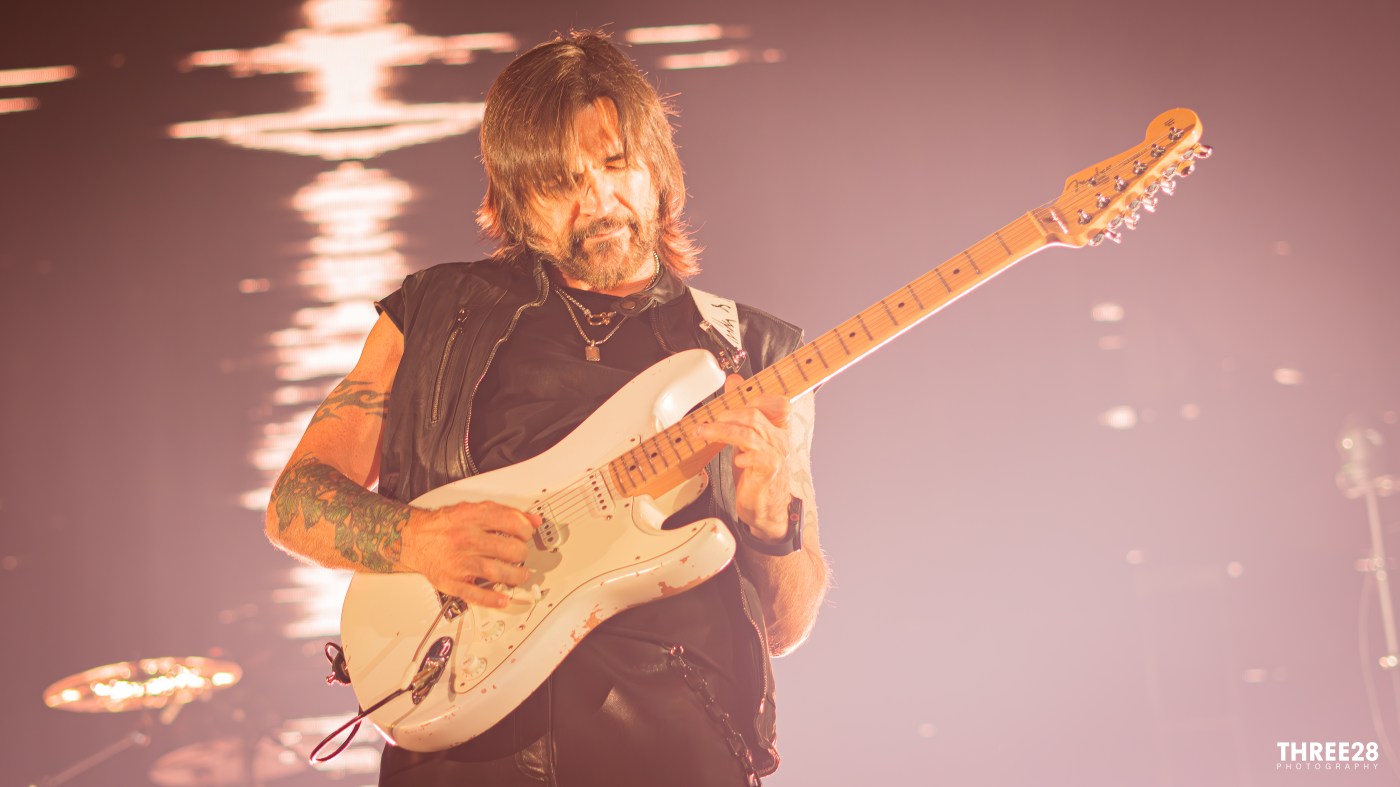
There is a particular kind of anticipation that settles over a sold-out concert when the audience knows it is about to witness something more substantial than a collection of songs. At the Coca-Cola Roxy, that anticipation was palpable long before Juanes appeared. Fans pressed towards their assigned seats, conversations carried an unmistakable nervous excitement, and the room seemed to vibrate with the expectation of a spectacle that had been years, perhaps decades, in the making. Then the lights dimmed, the screens awakened, and Juan Esteban Aristizábal Vásquez — better known to the world simply as Juanes — walked onto the stage with a Fender in his hands. The reaction was immediate. This was not merely an Atlanta stop on another tour; it was a reunion between an artist and an audience that has grown up with his music. With the recently released JuanesTeban, his 12th studio album, Juanes is not touring as a legacy act content to revisit yesterday’s accomplishments. Instead, he arrived determined to demonstrate why, after more than three decades of making music, his name remains synonymous with the evolution of Latin rock.


Few artists have occupied Juanes’ particular position in Latin music. Emerging from Medellín and first gaining prominence with the Colombian rock band Ekhymosis before embarking on his solo career, he became one of the artists who helped establish rock en español as a force capable of reaching far beyond its traditional audience. His breakthrough was never dependent on abandoning his Colombian identity; quite the opposite. Juanes fused rock guitars with Latin rhythms, romantic songwriting, folkloric influences and an unmistakably Colombian sensibility, creating a sound that could inhabit radio stations across Latin America while still sounding unmistakably like him. Over the course of his career, he has accumulated an almost absurd number of accolades and an even more remarkable collection of songs. His catalogue is so deep that a concertgoer can spend one song recognizing a teenage memory, the next remembering a first love, and the next discovering that Juanes somehow has another enormous hit waiting in reserve. The man has spent more than two decades turning personal songs into collective memories, and the Coca-Cola Roxy was packed with people eager to relive them.
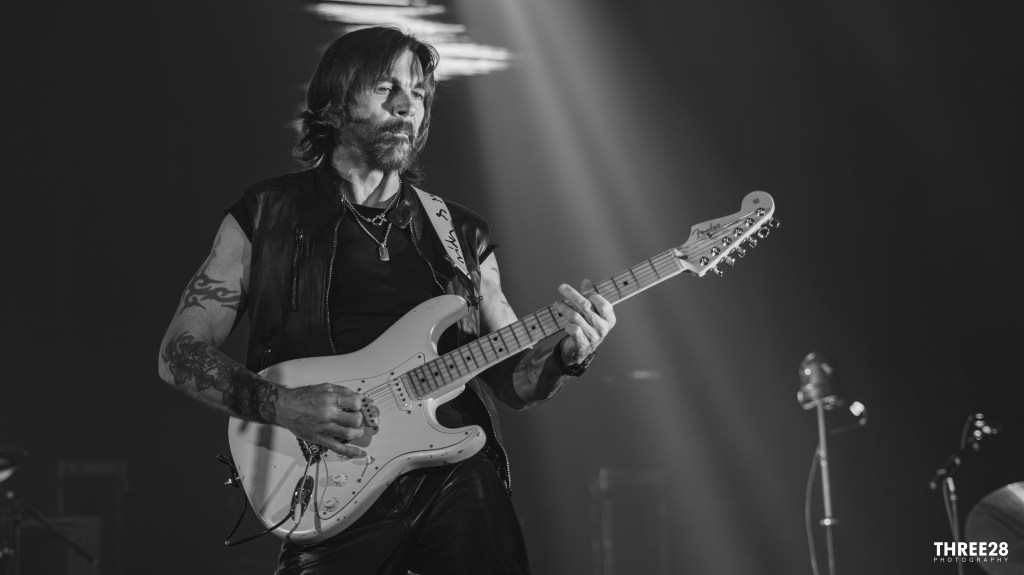
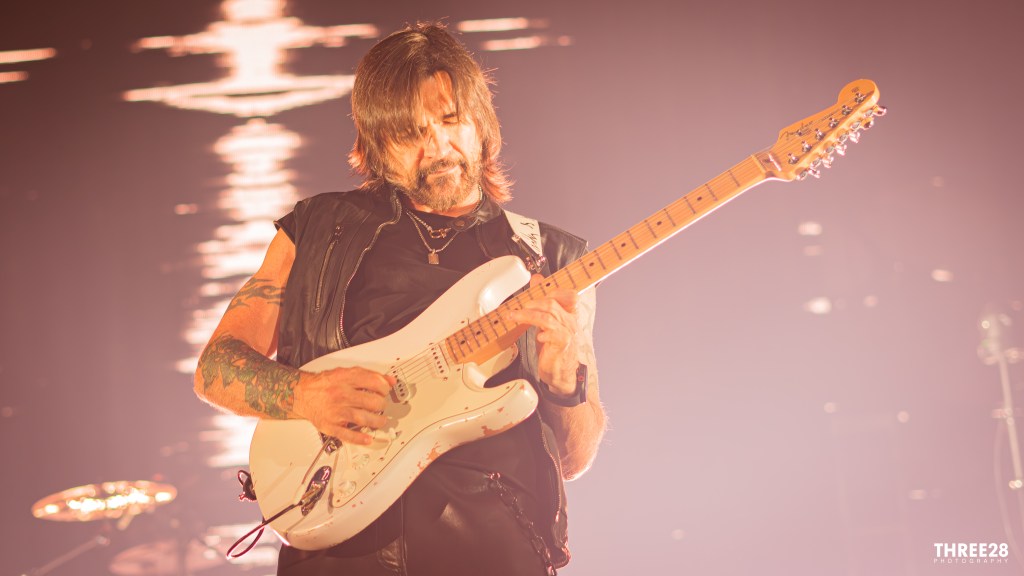
At 53, Juanes also possesses the curious appearance of someone who has negotiated an unusually favorable arrangement with time. The familiar long hair remains, framing a face that has matured without surrendering the youthful identity associated with his earliest international successes. More importantly, he remains visibly fit, energetic and physically engaged with the performance. There is no sense that he is preserving himself behind the safety of a microphone stand. He moves, bends into his guitar, smiles at the crowd and attacks his instrument with the physicality of a musician who still regards the stage as a place for exertion rather than exhibition. His Fender became the evening’s most convincing reminder that beneath the pop-star recognition and international reputation is a serious guitarist. Every chord seemed deliberate, every flourish confident, while the musicians surrounding him supplied a muscular Latin foundation that allowed the arrangements to move fluidly between rock, cumbia, salsa and pop. Juanes may have been the name on the marquee, but he performed as the leader of an ensemble rather than an isolated celebrity.
That versatility became particularly apparent as the concert unfolded. A song such as “Me Enamora” arrived with the exuberance of a classic, immediately provoking recognition throughout the room, yet Juanes never allowed nostalgia to become complacency. Later, “La Camisa Negra” transformed the venue into a massive sing-along, demonstrating why certain songs refuse to age even as their creator does. The brilliance of Juanes’ catalogue is that these compositions do not feel like artifacts retrieved from an earlier era; they remain functioning pieces of popular culture. The audience knows the melodies instinctively. They know when the guitar should surge, when the chorus is coming and, frequently, they know the words better than they probably realized. The new material from JuanesTeban consequently had an interesting job: it needed to coexist with songs that have been embedded in listeners’ lives for years. Rather than competing with the past, the newer music provided another chapter in a career that continues to expand. The album itself deliberately reconnects Juanes with Colombian and Latin American roots while preserving his appetite for rock, an approach that mirrors the concert’s genre-hopping character.
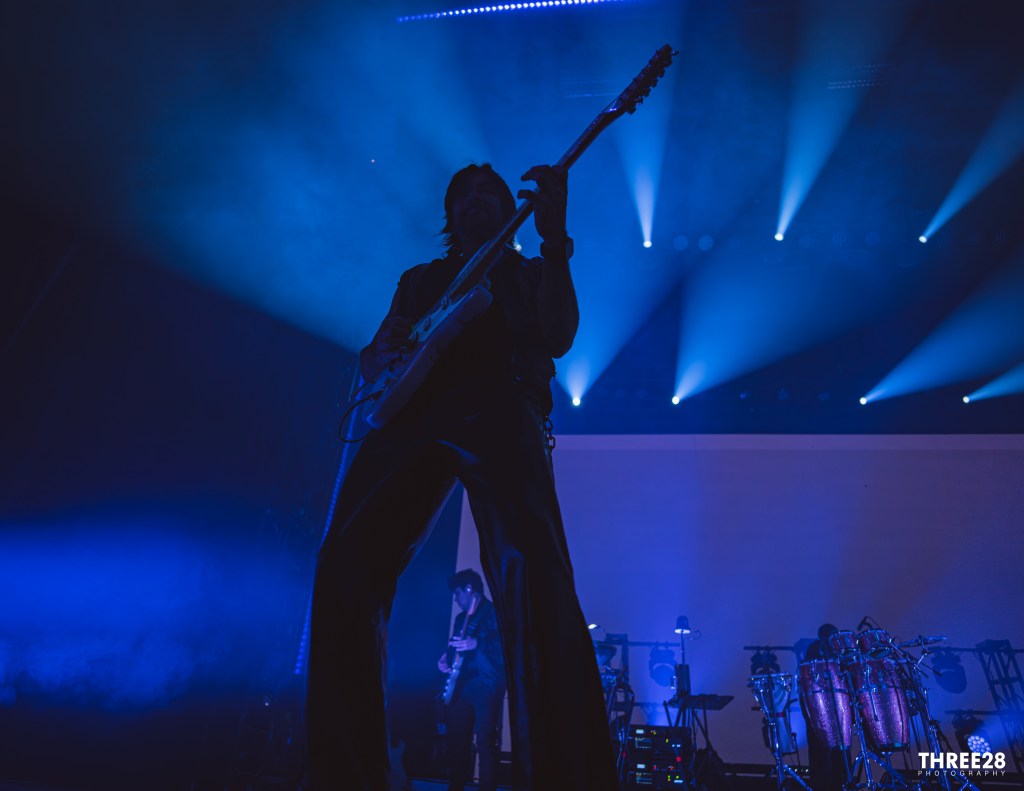
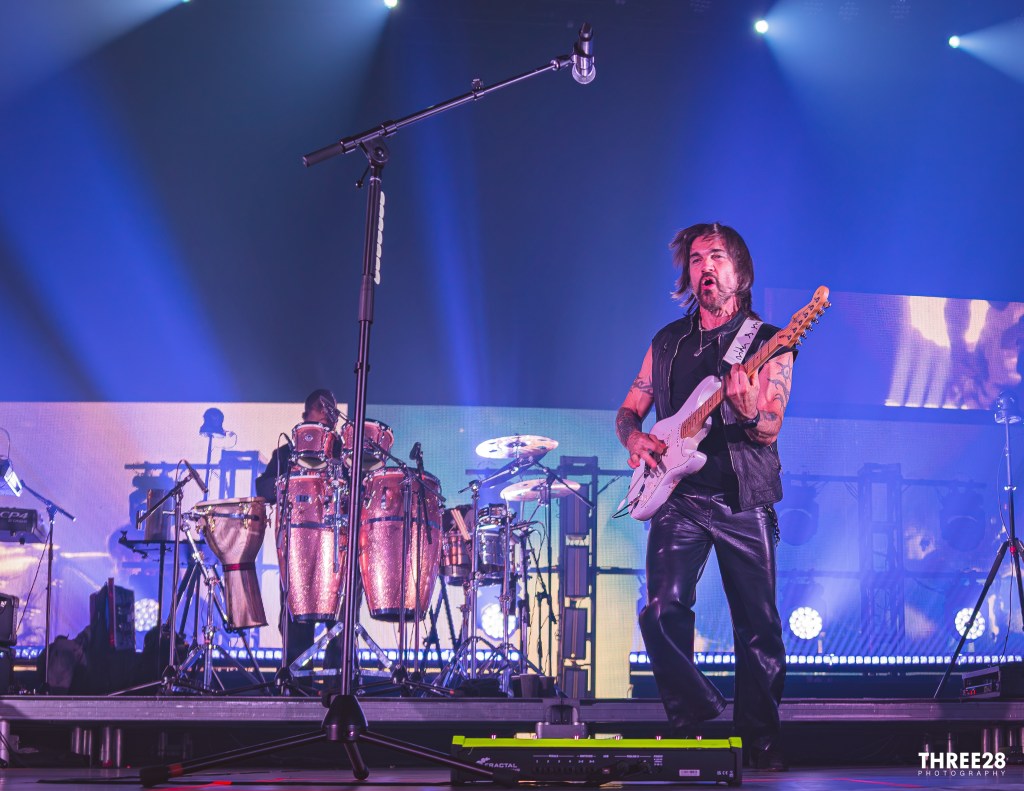
Juanes’ affection for American rock, however, received perhaps its most entertaining showcase when he abandoned the boundaries of his own catalogue for a series of raucous jam-session moments. The familiar opening of Metallica‘s “Enter Sandman” suddenly ripped through the Roxy, followed by the unmistakable riff of The White Stripes‘ “Seven Nation Army.” It was a revealing detour. For an artist so closely associated with Latin music, Juanes has never treated the genre as a wall separating him from the music he loves elsewhere. Rock, metal, funk, salsa, cumbia and other influences have always been ingredients in his musical vocabulary. Even Juanes’ own playlists and public musical references have long reflected that fascination with heavier guitar music. Onstage, the covers felt spontaneous rather than ceremonial, as if the superstar had momentarily invited the audience into his rehearsal room to show them what he listens to when nobody is asking him to perform one of his hits.
Yet the concert’s most affecting sequence arrived when Juanes deliberately reduced the scale of the spectacle. For “Para Tu Amor,” he stepped away from the main stage and established a small acoustic performance in the middle of the audience, surrounding himself with fans rather than separating himself from them. The production suddenly became secondary. Phones rose into the air, people leaned toward the music, and the enormous room acquired the intimacy of a private gathering. Then the evening produced one of those unscripted concert moments that no lighting designer can manufacture: a man proposed to a woman in the crowd, and she said yes. The reaction was instantaneous, an eruption of cheers that temporarily overwhelmed the music itself. Juanes had spent the night demonstrating the communal power of songs, but here that idea became tangible. A composition written and recorded years ago had become the soundtrack to an entirely new chapter in two strangers’ lives. Una noche inolvidable, indeed.


The journey backward continued when Juanes returned to his Colombian roots through Joe Arroyo‘s “La Noche” and “Rebelión.” These performances were more than obligatory nods to national heritage; they demonstrated the musical lineage from which Juanes emerged. His interpretation of Arroyo’s work allowed the evening to breathe with Caribbean rhythm while preserving the rocker’s instinct for guitar-driven momentum. The contrast was exhilarating. One moment Juanes was inhabiting the language of American hard rock, and the next he was channeling one of Colombia’s most revered musical figures. Behind him, the enormous screens intensified the transitions with elaborate graphics and visual sequences that gave the production a cinematic dimension. Images, patterns and shifting displays moved in harmony with the music, creating an environment that felt considerably larger than the physical dimensions of the Roxy. The screens never became the star, however; they functioned as a visual extension of the songs, magnifying their emotional temperature.
Between those musical excursions, Juanes repeatedly returned to the human themes that have helped sustain his career. He spoke directly to the audience about how music can unite people and how parenthood provides another profound point of connection between individuals who might otherwise have little in common. He also reflected on the strange contradiction of a life spent constantly traveling: how an artist can cross continents and still find a sense of home because of the people who continue to show up. His gratitude toward his patrons — the fans who buy the tickets, learn the words and return years later — did not sound like a rehearsed obligation. It seemed to be part of his understanding of what a career actually means. The stage may be temporary, he suggested, but the relationship between performer and audience can become something enduring. That sentiment made the concert feel less like a transaction and more like a gathering of people who have shared a musical history.

By the time Juanes reached “A Dios Le Pido,” the evening had effectively come full circle. There was no need for elaborate explanation; the song itself carried more than enough history. The opening notes triggered a response that seemed to travel through the entire building, and when the chorus arrived, the crowd took possession of it. Thousands of voices sang together in unison, reducing the distinction between the man holding the string instrument and the people standing before him. Juanes could have stopped singing altogether and the song would have continued without him. That was the most fitting conclusion to a concert built around connection: after more than 20 years of solo stardom, an enormous catalogue, countless stages and an entirely new album, Juanes was still able to stand in an Atlanta venue and make thousands of people sing as though they were one voice. The spectacle was impressive, but the deeper achievement was more difficult to manufacture — longevity without irrelevance, evolution without abandoning one’s roots, and fame without losing the sense that music is ultimately about people.


Leave a Reply