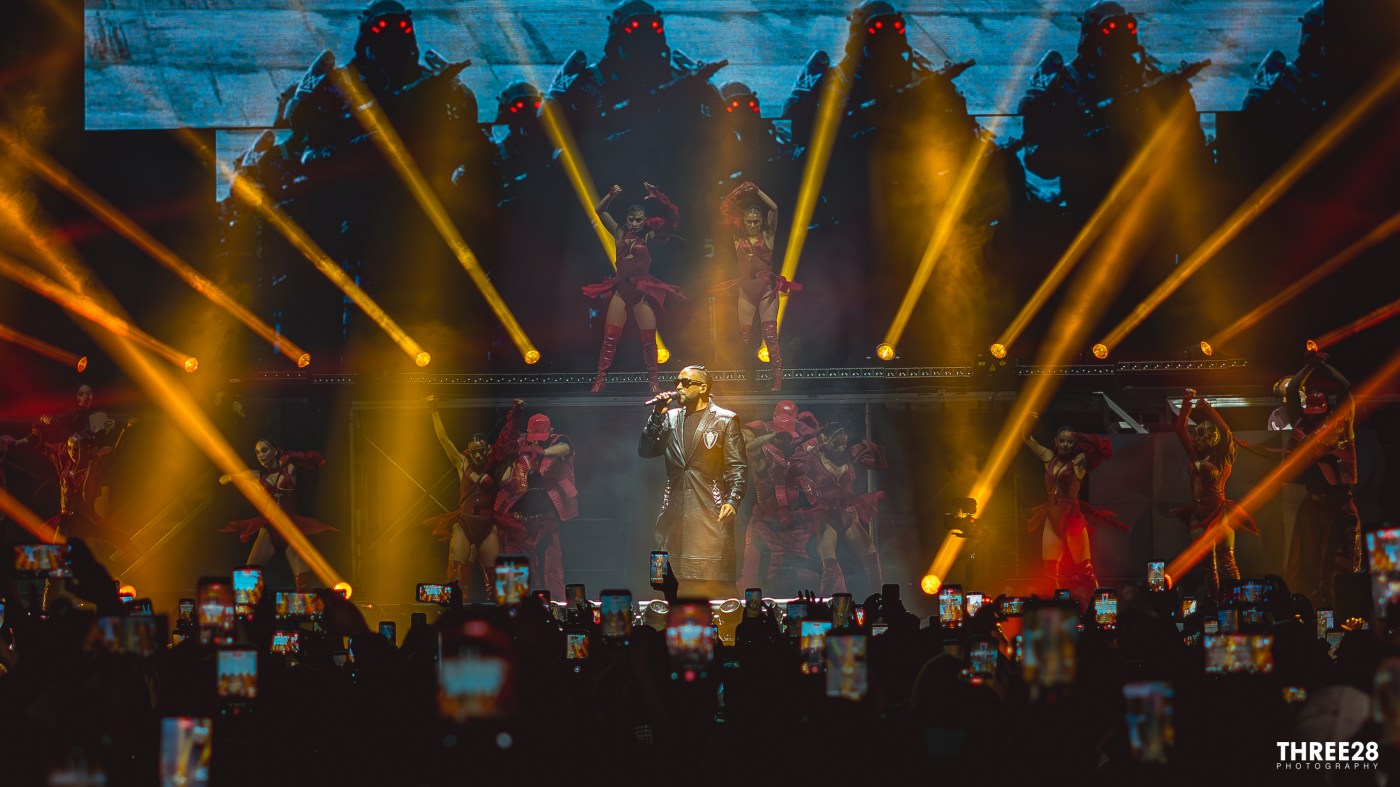
Don Omar has never been a figure content with merely occupying a place in reggaeton history; he has always seemed intent on ruling it. At State Farm Arena, his The Last King Tour unfolded before a sold-out crowd of devoted believers, many of whom appeared less interested in witnessing a concert than participating in a coronation. The atmosphere was charged with the anticipation of a long-awaited reunion between an artist and the musical movement he helped propel into global consciousness. Don Omar, born William Omar Landrón Rivera, emerged during reggaeton’s formative years, when Puerto Rican underground music was transitioning from a controversial, locally rooted phenomenon into an international commercial force. His rise was not accidental. Combining the rhythmic foundations of dancehall and Latin Caribbean music with melodic instincts, commanding vocals, and a flair for theatricality, he helped transform reggaeton into a genre capable of dominating clubs, radio stations, and arenas far beyond the Caribbean. The evening served as a reminder that, although musical fashions change and younger contenders continually emerge, the crown remains a compelling accessory when its owner knows how to wear it.
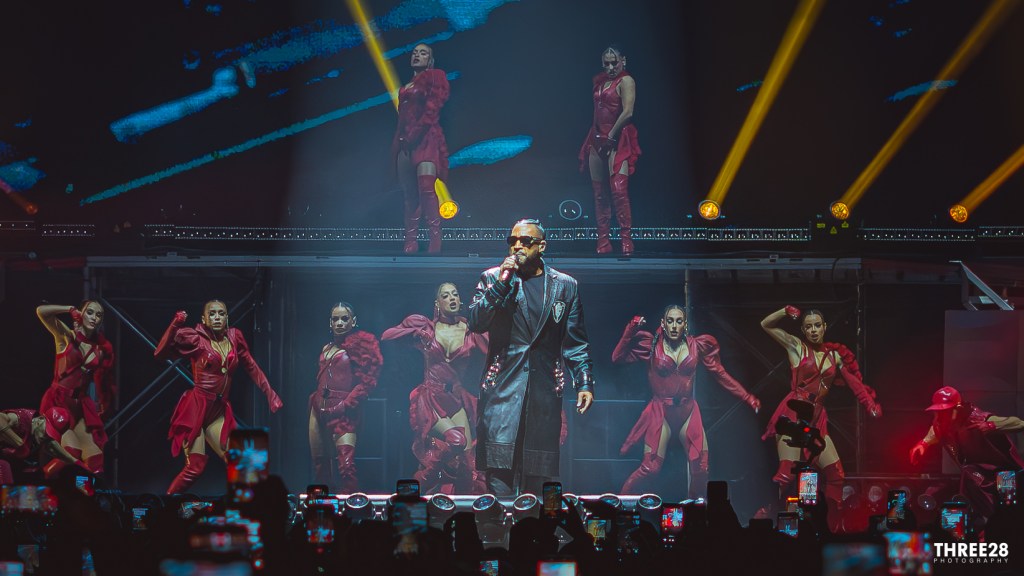
Don Omar’s ascent belongs to a pivotal chapter in Latin music, when reggaeton was still defining its identity and negotiating its place in the mainstream. His 2003 debut album, The Last Don, established him as a major force, while subsequent releases cemented his reputation as one of the genre’s most commercially successful and artistically versatile performers. Tracks such as “Dile,” “Danza Kuduro,” “Salió el Sol,” and “Pobre Diabla” demonstrated his ability to move between romantic melodrama, club-ready rhythms, and crossover anthems without losing his distinctive vocal identity. His contemporaries included Daddy Yankee, whose entrepreneurial instincts and global breakthrough with “Gasolina” made him an indispensable architect of reggaeton’s expansion; Tego Calderón, whose Afro-Caribbean sensibilities and socially conscious perspective gave the genre considerable depth; and Wisin & Yandel, whose partnership helped establish the commercial possibilities of the reggaeton duo. Then there was the rivalry with Daddy Yankee, a competition that became emblematic of the genre’s golden era. Their contrasting personas, competitive histories, and respective catalogs invited endless debates over supremacy. Yet the rivalry was never simply a matter of sales or chart positions. It concerned cultural influence, longevity, versatility, and the ability to produce songs that could survive long after the nightclub lights came on. In reggaeton, the throne has always been crowded, and its contenders have rarely been known for their modesty.
The production announced its ambitions before Don Omar even needed to establish his authority. The stage was constructed in multiple tiers, creating a monumental performance space that resembled a command center designed for a particularly well-funded military campaign. Towering visual elements, elaborate screen graphics, and relentless sequences of high-intensity lighting transformed the arena into a spectacle of movement and precision. Don Omar’s face and silhouette appeared in imposing digital treatments, while flags representing Latin American nations and other parts of the region flashed across the screens, turning the production into a celebration of a musical community whose borders are more cultural than geographical. The graphics were not merely decorative wallpaper for a man with a microphone; they were integral to the evening’s visual narrative. Light beams cut through the darkness, screens shifted between imagery and abstraction, and the tiered architecture gave the performance a sense of vertical scale. There was a distinctly militaristic character to the proceedings, as though the evening had been conceived as a campaign to reclaim territory rather than simply entertain an audience. If reggaeton is a battlefield, Don Omar arrived with considerable artillery.
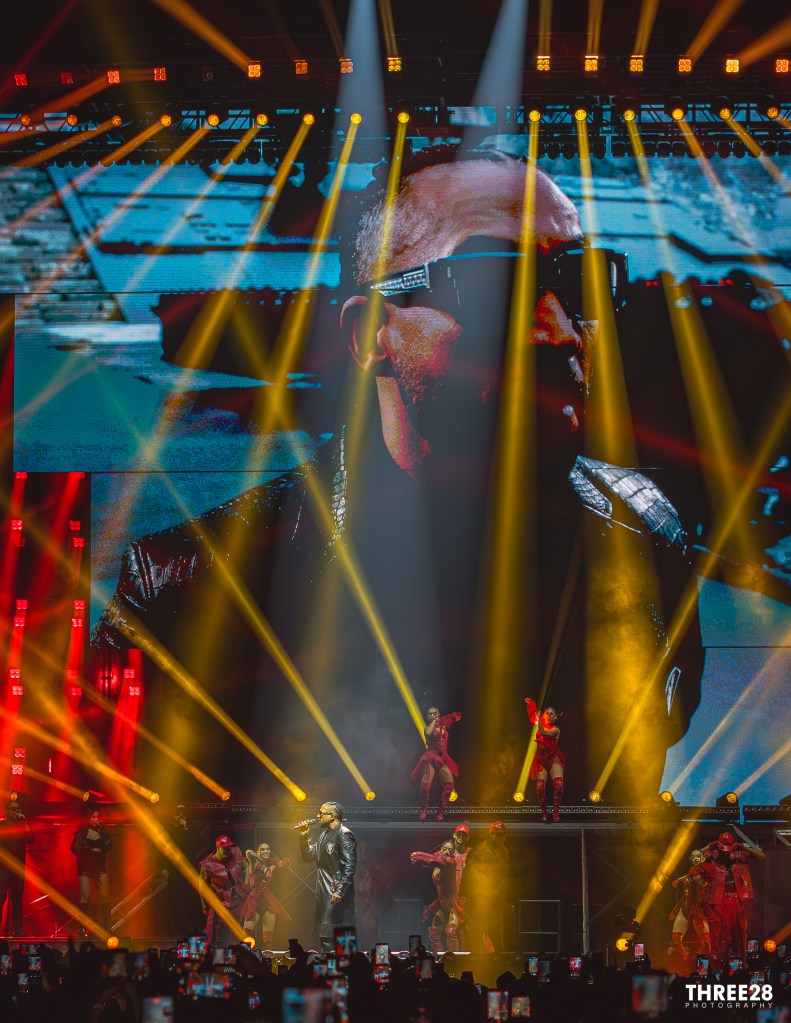
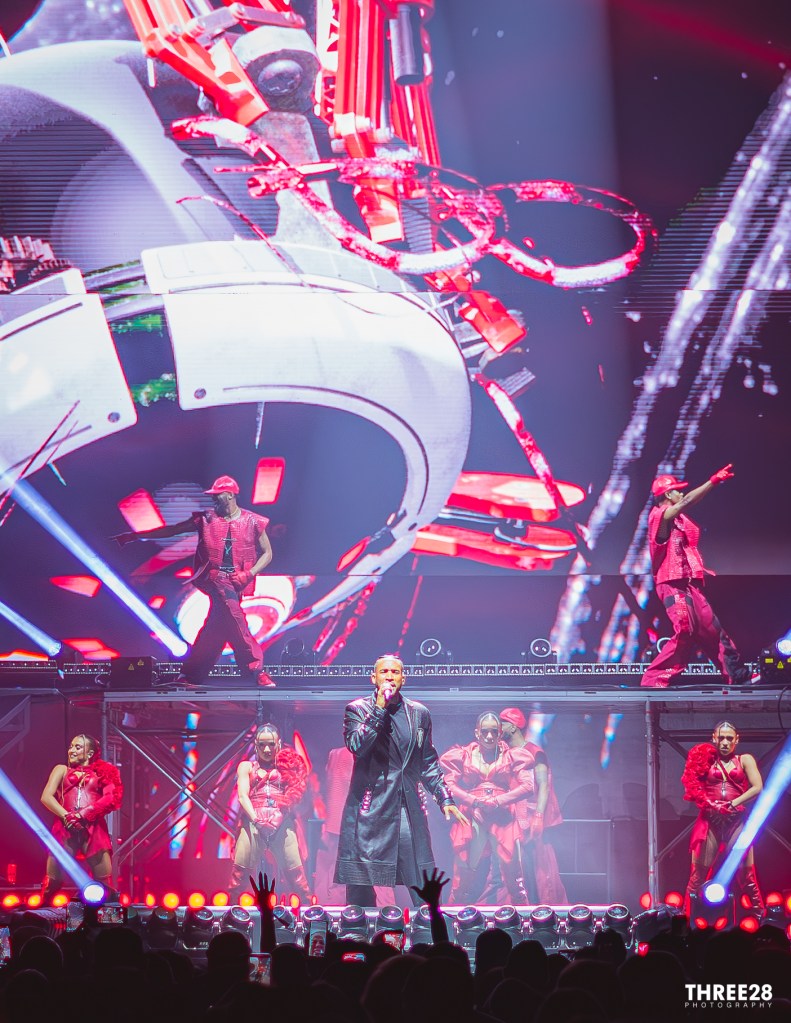
The military aesthetic extended naturally into the choreography, where an army of female dancers moved with synchronized discipline around their commanding figure. Their presence lent the production a blend of martial precision and nightclub sensuality, reinforcing the impression that Don Omar was presiding over a regiment assembled in his honor. A DJ anchored the musical proceedings, helping maintain the rhythmic continuity between the concert’s different moods, while the dancers supplied much of the kinetic energy that kept the stage in perpetual motion. Don Omar himself appeared in several black leather ensembles, their sleek silhouettes and dark styling occasionally evoking a reggaeton interpretation of The Matrix. One half expected him to offer the audience a choice between the red pill and the blue pill, although the sold-out crowd had already made its decision: there would be no returning to ordinary reality tonight. The wardrobe choices complemented the show’s commanding visual language, presenting an artist who understood that a concert of this scale requires more than a recognizable voice. It requires a character, a mythology, and the confidence to inhabit both. Between the lighting, the costumes, the dancers, and the imposing digital imagery, the flames and rising sparks, the production rarely allowed the audience’s attention to wander. Subtlety, clearly, had not made the guest list.
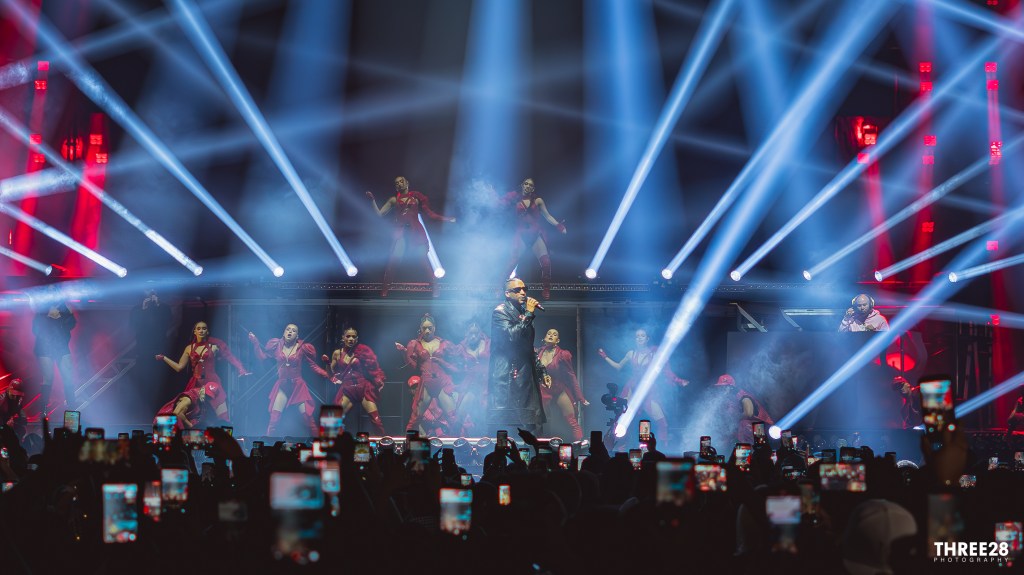
For all its visual ambition, however, the evening’s most persuasive spectacle remained the audience itself. The sold-out arena was packed with die-hards who responded to Don Omar not merely as an entertainer but as a defining voice of their musical generation. His catalog carries the emotional associations of adolescence, first romances, late-night parties, summer road trips, and the formative years when reggaeton began moving from neighborhood sound systems into the international mainstream. The crowd’s enthusiasm reflected that history, transforming familiar songs into collective declarations of allegiance. Don Omar also took time to acknowledge Latin American nations, offering shout-outs that prompted waves of recognition throughout the venue. Mexico, Puerto Rico, and Colombia elicited some of the loudest cheers, although the enthusiasm extended well beyond those three countries. Flags representing Latin nations appeared across the screens, placing national identities within a broader celebration of shared cultural heritage. The effect was especially fitting for an artist whose music has traveled across linguistic and geographic boundaries, connecting audiences through rhythms that require little translation. These moments elevated the concert beyond a display of individual stardom; they became an affirmation of the community that sustained the genre’s rise. The King may have occupied the throne, but the kingdom was unmistakably present in the stands.
Naturally, a performance built around such an imposing title invites an unavoidable question: does Don Omar belong on reggaeton’s Mount Rushmore? The answer depends on the criteria, which is precisely what makes the debate worthwhile. Daddy Yankee possesses an almost unassailable claim through his role in bringing reggaeton to a worldwide audience, while Tego Calderón deserves recognition for his foundational influence and distinctive Afro-Caribbean artistry. Wisin & Yandel helped define the genre’s commercial architecture, and contemporary superstars such as Bad Bunny have carried its influence into an entirely new era of global pop. Don Omar, meanwhile, brings a formidable combination of vocal identity, commercial success, stylistic versatility, and enduring anthems. His ability to move between the romantic intensity of “Dile” and the international dance-floor appeal of “Danza Kuduro” illustrates a range that few artists can match. Whether he occupies one of the four most defensible positions depends on whom one asks, but excluding him from the conversation would require a particularly selective understanding of reggaeton history. Mount Rushmore, after all, was never intended to accommodate an entire musical movement. The mountain might need expanding.
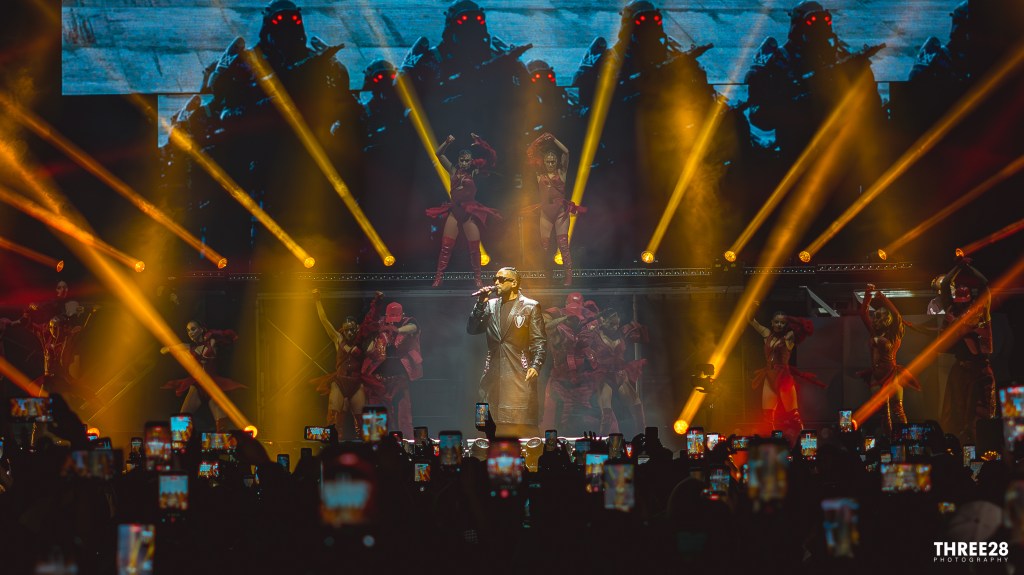
Ultimately, The Last King Tour succeeded by understanding the distinction between nostalgia and legacy. Nostalgia asks audiences to remember who they were when a song first entered their lives; legacy demonstrates why that song still matters. Don Omar delivered both, supported by a production that combined theatrical ambition, militaristic pageantry, and a visual vocabulary worthy of its regal premise. The leather-clad entrances, disciplined dancers, imposing graphics, mesmerizing pyrotechnics and thunderous national shout-outs provided the spectacle, but the audience supplied the emotional substance. There was an occasional excess to the presentation, as though every available lighting fixture had been ordered to prove its loyalty to the crown. Yet restraint was hardly the point. This was a celebration of an artist whose career helped shape the sound of modern Latin popular music, performed for a crowd that required no reminder of his significance. Whether Don Omar is the undisputed king or one of several monarchs in reggaeton’s crowded royal court remains open to debate. What became abundantly clear that evening was that his subjects had not deserted him. The throne, at least for one night, remained firmly occupied.


Leave a Reply