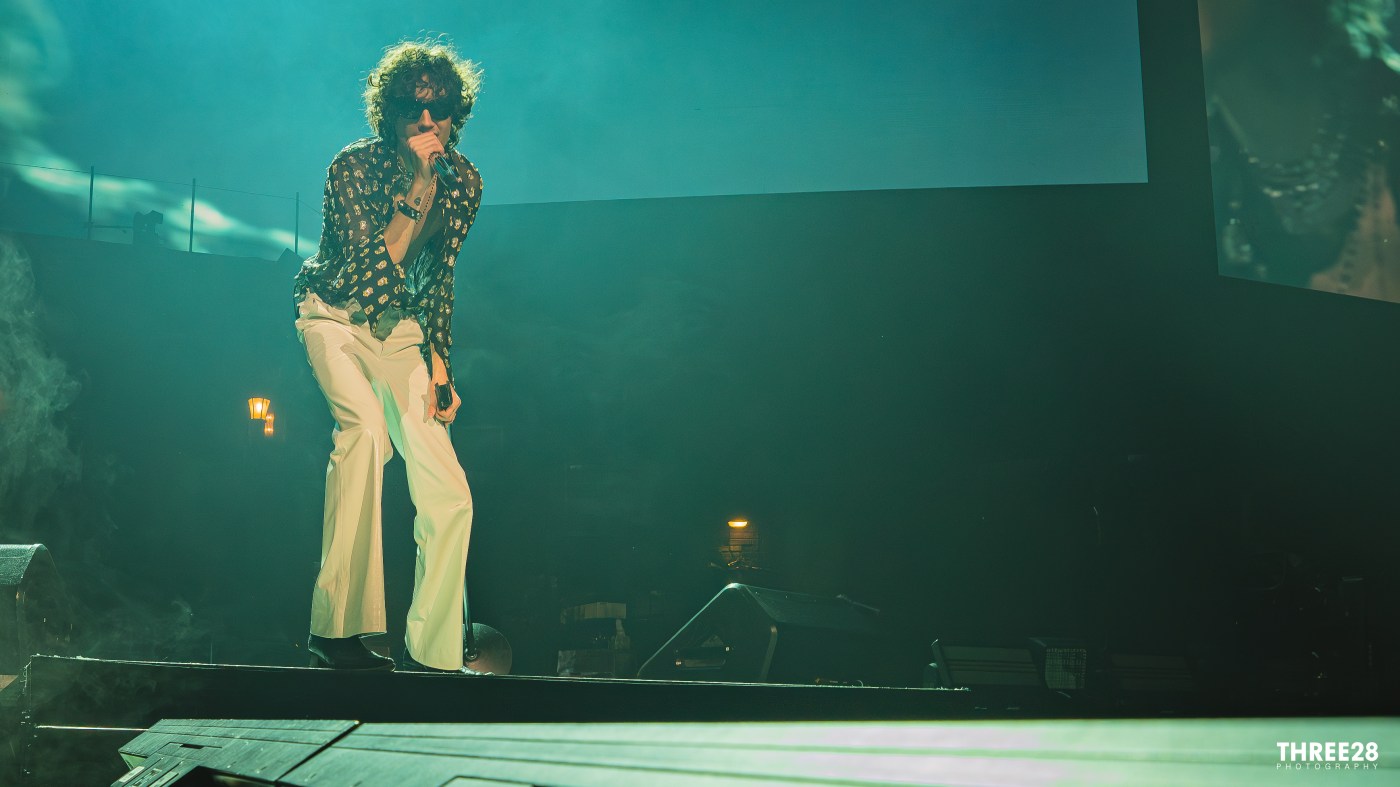
Sombr has arrived at the peculiar intersection where internet virality, adolescent heartbreak, and rock-star mythology converge, and his You Are The Reason Tour makes a compelling case for taking that combination seriously. Born Shane Michael Boose, the New York native began writing and recording music as a teenager, developing an audience through bedroom recordings before the singles “Back to Friends” and “Undressed” propelled him into mainstream consciousness. Social media, particularly TikTok, helped transform his emotionally charged songs into widely shared anthems, but reducing his success to algorithmic fortune would overlook his instinct for melody and his ability to translate romantic uncertainty into enormous, immediately accessible choruses. At State Farm Arena, the audience was packed, although the building was not entirely sold out, an important distinction that did little to diminish the atmosphere. The crowd arrived ready to participate rather than merely observe, singing with the conviction of people who had found their own experiences reflected in his lyrics. Sombr’s achievement is not simply that he has become famous quickly; it is that he has cultivated a fandom that treats his songs as emotional permission slips, encouraging listeners to embrace vulnerability, romantic disappointment, and the awkward business of becoming oneself. His appeal rests on the suggestion that insecurity need not be concealed to become a source of strength.
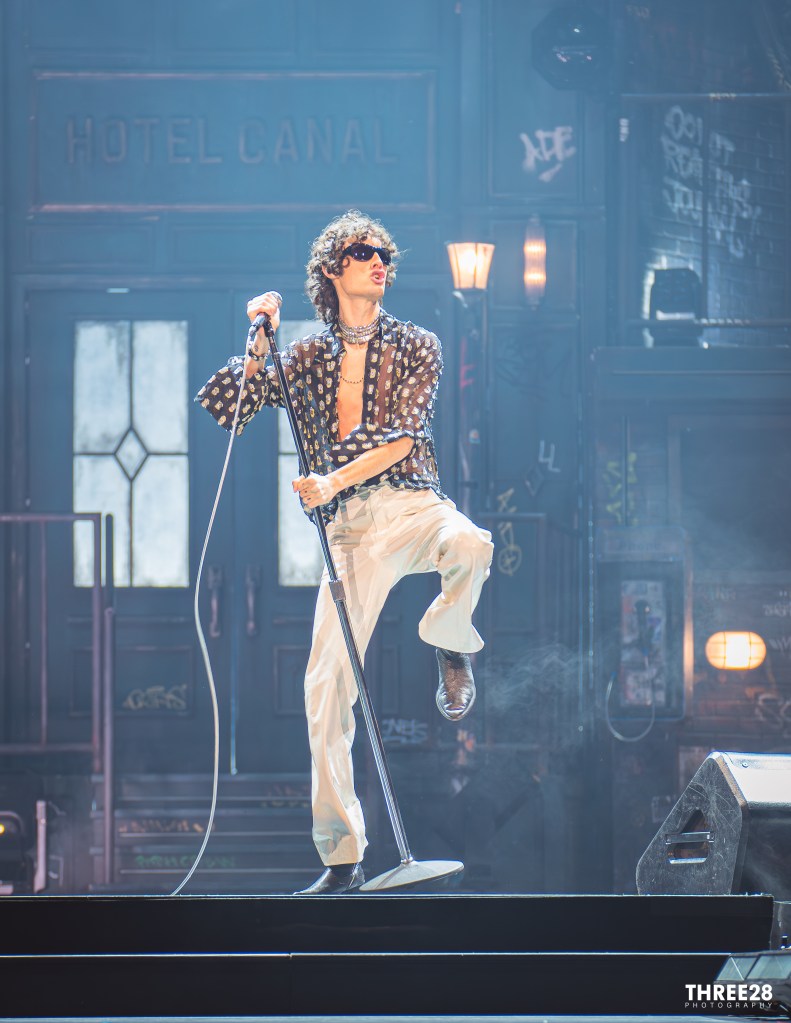
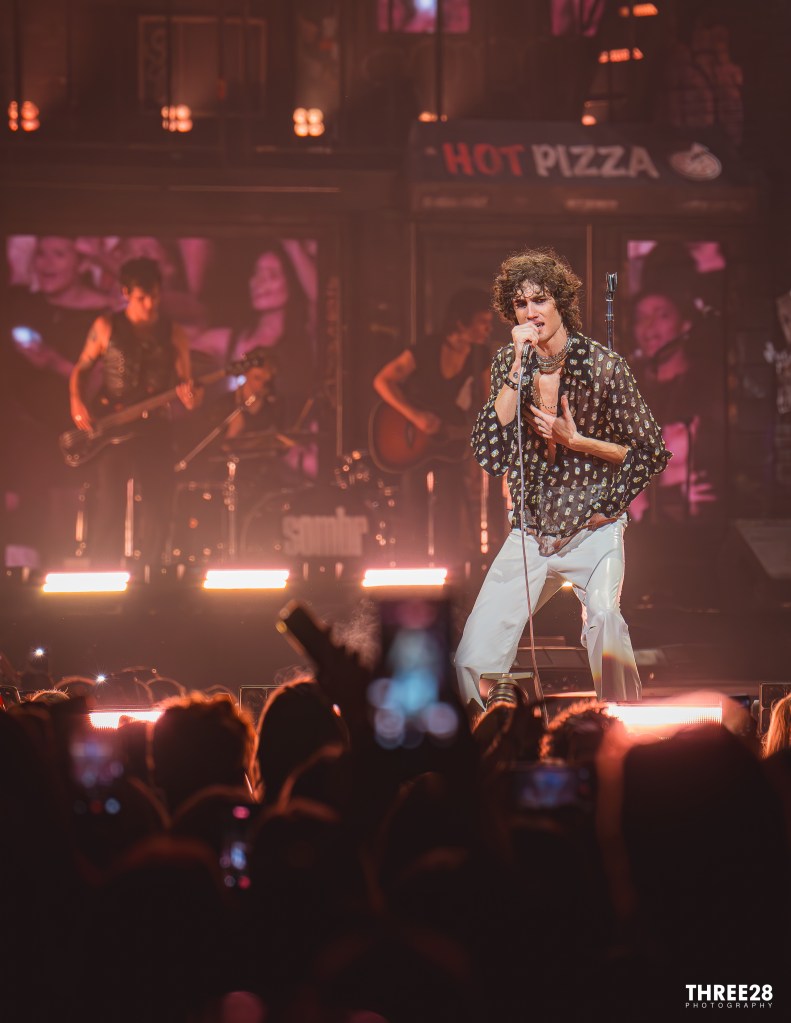
The production establishes its own mythology before Sombr even appears. The stage resembles a stylized New York street, complete with a pizza shop, abundant graffiti, a street telephone, and the side staircases of tenement buildings. Although the intended setting is early-1990s New York, the visual language feels closer to the grimy, theatrical urban landscape of the 1979 cult film The Warriors: a city of shadowy corners, exaggerated street characters, and romanticized disorder. The distinction is not necessarily a flaw. This is not a documentary reconstruction of a particular decade so much as an impressionistic cityscape assembled from familiar cinematic references, and its deliberate artificiality suits an artist whose music frequently turns private feelings into grand gestures. At the center stands the entrance marked “Hotel Canal,” integrated into the stage’s architecture and connected to a catwalk extending into the audience. When Sombr emerges through those doors, the hotel becomes more than a decorative prop: it establishes the evening as a passage into his constructed world. The name also carries a personal resonance, evoking Canal Street and the Manhattan geography associated with his New York upbringing. A hotel is, after all, a place of temporary residence, chance encounters, departures, and strangers crossing paths; those themes sit comfortably alongside songs about relationships that change their meaning overnight. The setting is gritty in appearance but carefully composed in execution, an urban fantasy with considerably more art direction than actual grime.
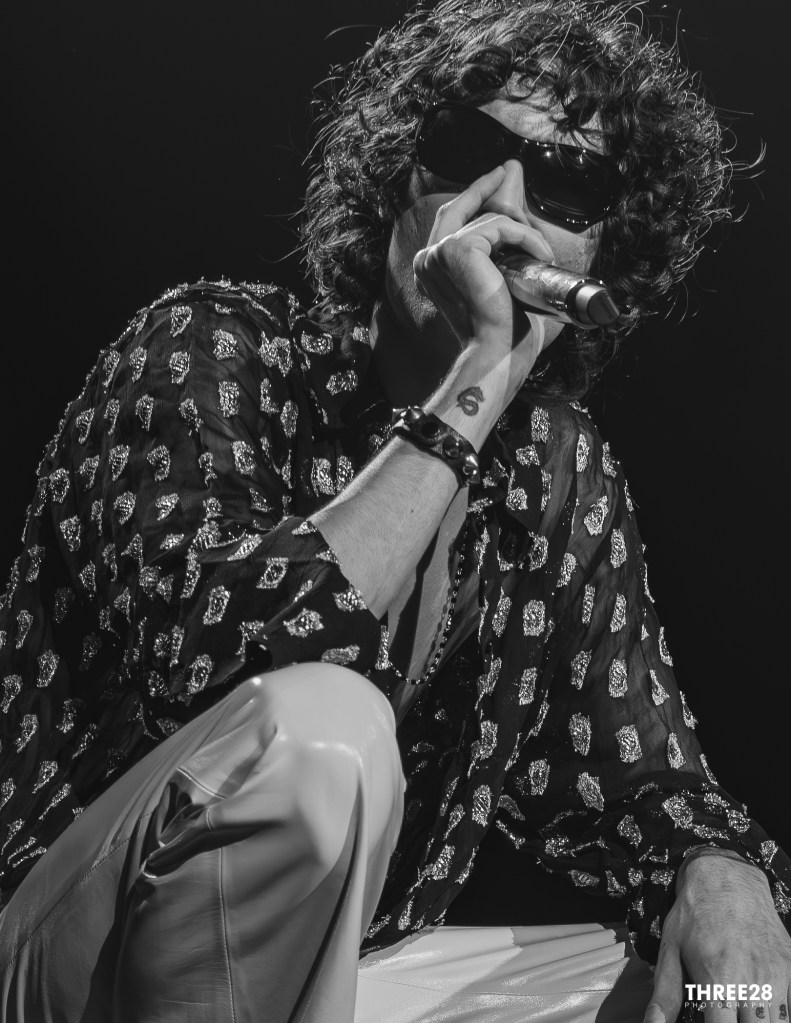
Sombr enters looking every inch the contemporary pop interpretation of a rock star, dressed in white trousers, a black shirt, and high-heeled shoes that give his slender silhouette an unexpectedly commanding elegance. The styling is effective without appearing particularly revolutionary, and that distinction matters. He is not attempting the confrontational abrasiveness of a Yungblud, whose performance persona often leans into punk provocation and unruly theatricality. Sombr occupies a softer, more polished territory: romantic, flamboyant, faintly mischievous, and keenly aware of the camera-ready possibilities of a dramatic entrance. His rock-star credentials are less about rebellion against convention than the careful manipulation of familiar conventions. He strides across the stage, works the catwalk, and presents himself with the assurance of someone who understands that a concert is both a musical performance and a visual argument. Occasionally, the gestures seem almost too perfectly arranged, as though the young artist has studied the iconography of stardom and is determined to deliver every expected detail. Yet there is something appealing about the ambition. He is not pretending that charisma happens by accident; he is building a language of his own from clothes, movement, lighting, and attitude. The result is not quite dangerous, not especially cool in the aloof, untouchable sense, but undeniably engaging. Sombr is selling the possibility of a rock star who would rather confess his feelings than smash a guitar, and whose most potent weapon is a chorus that the audience already knows by heart.
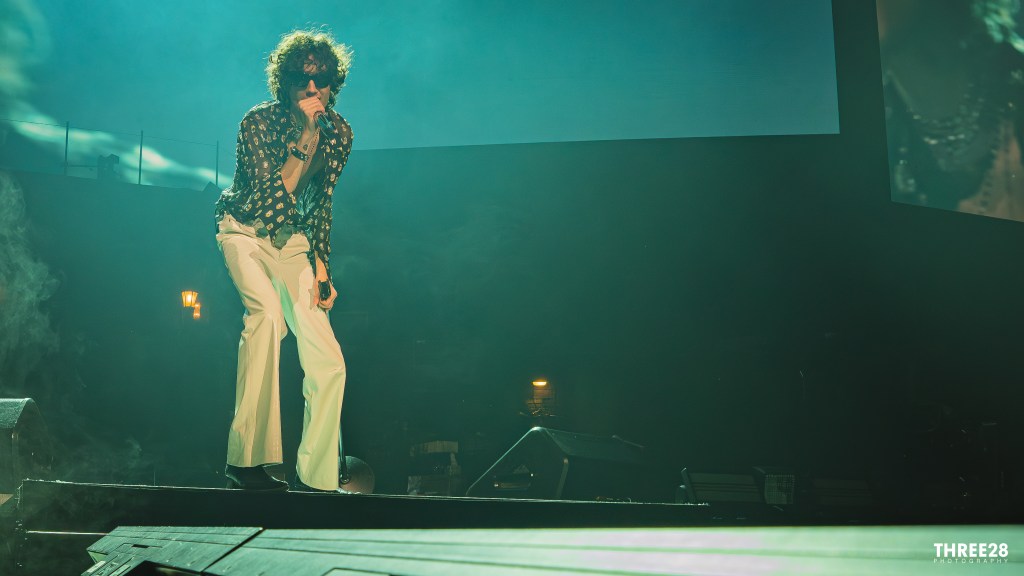
The theatricality becomes more revealing when Sombr begins discussing his insecurities, particularly his discomfort with his own body. Before performing “My Body Isn’t Ready,” he has used such confessions to connect with listeners who recognize the exhausting distance between how they feel and how they believe they ought to look. There is genuine value in an artist of his generation making room for that conversation, especially within a culture that routinely treats appearance as a public referendum. Yet Sombr’s presentation introduces an intriguing contradiction: while discussing vulnerability, he also moves about the stage unbuttoning his shirt, eliciting the sort of ecstatic screaming usually reserved for established heartthrobs. The gesture is hardly unusual in pop performance, but its juxtaposition with his confessional messaging invites scrutiny. Is he challenging the audience’s expectations of masculinity and physical desirability, or transforming insecurity into another carefully calibrated instrument of attraction? Perhaps both. His image is undeniably curated, from the languid gestures to the carefully exposed skin, and the tension between sincerity and spectacle is part of the appeal. The danger is that vulnerability can become another costume when every admission arrives wrapped in a seductive pose. Nevertheless, dismissing the performance as calculated would be too easy. His willingness to articulate discomfort may genuinely reassure fans, even when the delivery is designed to make them swoon. Sombr is learning that a pop star can reveal his insecurities without surrendering his mystique; indeed, sometimes the confession is what makes the mystique work.
Musically, the concert is strongest when the production gives the songs room to carry the emotional weight. “Undressed” exemplifies Sombr’s knack for turning romantic hesitation into something expansive, pairing an intimate premise with a sweeping, guitar-driven arrangement that invites the crowd to transform personal anguish into collective catharsis. “Back to Friends,” meanwhile, remains the defining expression of his particular gift: the uncomfortable recognition that intimacy can survive a breakup in altered form, leaving former lovers stranded between familiarity and estrangement. Its resonance lies in the way the melody makes emotional confusion feel almost exhilarating. These songs explain why his following extends beyond casual appreciation of a viral hook. His listeners do not merely consume heartbreak; they perform it together, singing the lyrics back with the fervor of a communal ritual. Still, the set occasionally reveals the limitations of an aesthetic built around perpetual romantic drama. The emotional register can become narrow, and the grand gestures sometimes threaten to overwhelm the subtler qualities of the songwriting. The polished arrangements and conspicuous staging also leave relatively little room for the unpredictability that makes a great rock performance feel genuinely volatile. Sombr is more pop architect than reckless garage-band frontman, and that is not a criticism in itself. His instincts are directed toward memorable refrains, visual coherence, and the construction of an immersive experience rather than instrumental chaos. If he is to develop into a lasting artist rather than a momentarily ubiquitous one, he will need to keep expanding the emotional and musical vocabulary that currently serves him so well.
Ultimately, the You Are The Reason Tour presents Sombr as a performer in the process of discovering how much mythology a young artist can build around himself before the construction begins to show. The crowded arena, the elaborate street-corner set, the “Hotel Canal” entrance, and the audience’s unrestrained response all testify to the extraordinary speed with which he has translated internet attention into a convincing live spectacle. His greatest strength is the connection he fosters with fans who see their own romantic confusion and personal insecurities reflected in his work; his most obvious limitation is a tendency to package that connection so neatly that spontaneity occasionally feels secondary to presentation. The comparison with Yungblud is instructive: where the latter often channels rock-star energy into provocation, Sombr favors seduction, melancholy, and carefully staged imperfection. He is not the most abrasive figure in the contemporary rock revival, nor does he need to be. His appeal lies in making emotional openness look glamorous without entirely stripping it of its discomfort. There is a pun waiting in that New York set: Sombr may be checking into Hotel Canal, but he is certainly not checking out of the drama. The question is whether the artist behind the carefully arranged curls, dramatic wardrobe, and shirt-unbuttoning theatrics can continue surprising an audience that already adores the character. On this evidence, he has the songs, the ambition, and the audience to make the next chapter compelling. What remains is the harder task of ensuring that the star grows as interesting as the image.


Leave a Reply