
Rawayana has built a career around the proposition that music should feel less like a performance and more like an invitation to stay a little longer. The Venezuelan band, fronted by the charismatic Beto Montenegro, blends reggae, funk, pop, Caribbean rhythms, and Latin alternative into a sound that resists the boundaries of any single genre. Their ¿Dónde Es El After? Tour takes that philosophy to its logical conclusion, turning a concert into an extended celebration of community, cultural identity, and the glorious irresponsibility of a night without a predetermined ending. At Synovus Bank Amphitheatre, a sold-out crowd arrived prepared to do considerably more than admire the musicians from a distance. Venezuela jerseys appeared throughout the audience, transforming the gathering into something resembling a national reunion conducted through bass lines, dancing, and shared memories. The atmosphere was festive without feeling manufactured, with fans singing, moving, and acknowledging one another as though the band had arranged a particularly elaborate neighborhood gathering. Rawayana’s appeal extends beyond its breezy melodies: the group offers its audience a portable version of home, especially for Venezuelans whose relationship with their country may involve distance, displacement, or longing. That emotional dimension gives the party its substance. Beneath the cocktails, choreography, and sun-drenched grooves lies a celebration of belonging, one in which cultural pride is not an accessory but part of the evening’s central rhythm.
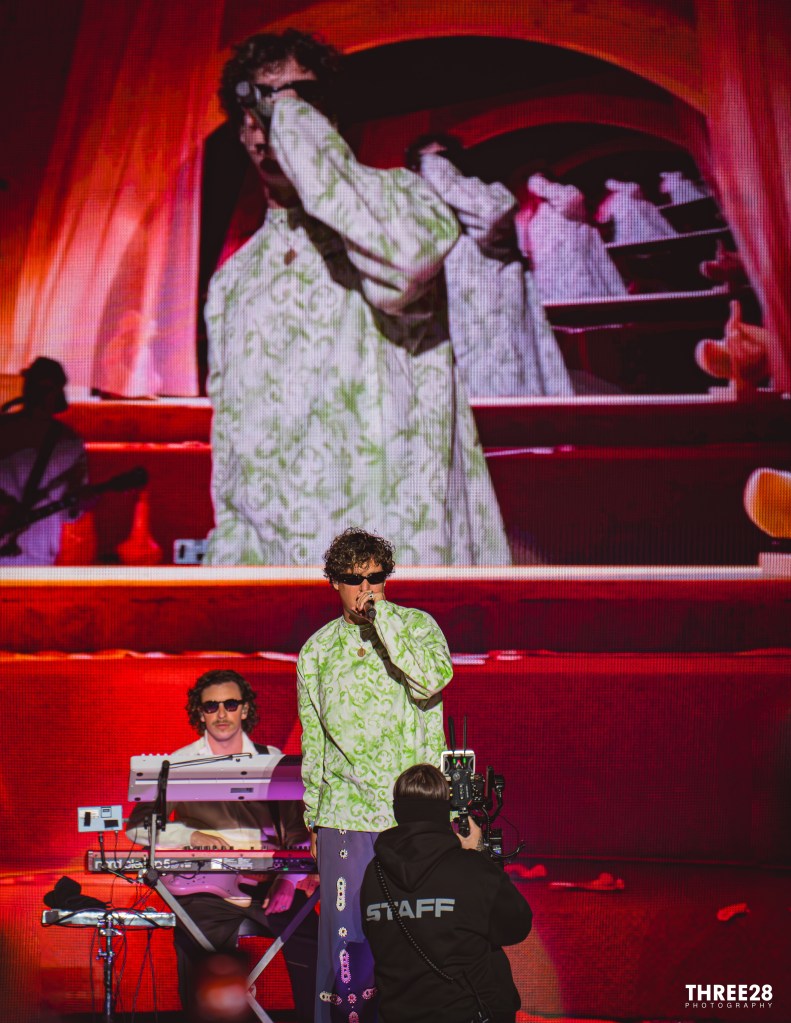
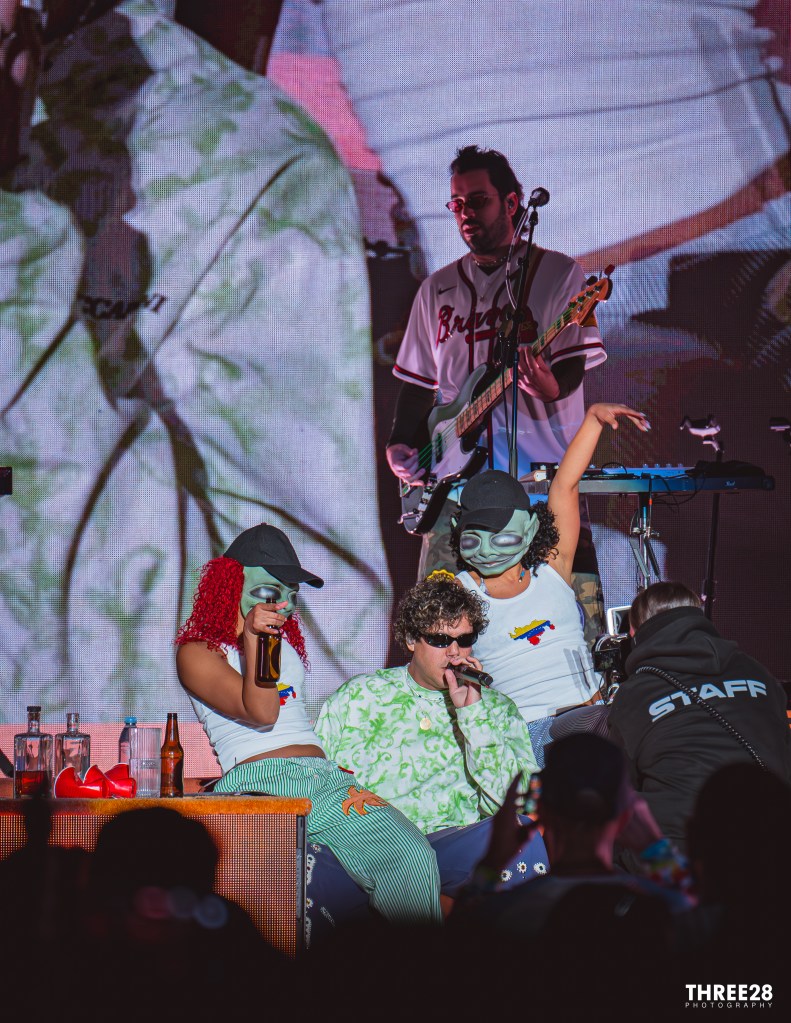
The stage design immediately establishes the appropriate setting, resembling an improvised gathering place assembled around the sort of table one might find outside a Latin neighborhood shop, where friends congregate over drinks and conversation stretches well beyond the original invitation. Red plastic cups reinforce the impression, suggesting that the evening has begun long before the audience arrived and that everyone present has simply been waiting for the music to catch up. Bamboo palms and what appear to be banana trees provide a tropical backdrop, softening the stage architecture and evoking the lush environments that inform much of the band’s musical vocabulary. The result is neither a literal recreation of a street corner nor an extravagantly polished fantasy resort. Instead, it feels like a familiar social space elevated into theatrical scenery, complete with the visual shorthand of an informal party that somehow keeps expanding. Before the band fully establishes its presence, an introductory film unfolds like a Latin fever dream directed by Robert Rodriguez: saturated imagery, exaggerated characters, cinematic swagger, and the suggestion that a perfectly ordinary evening is about to veer into gloriously improbable territory. The video sets the tone without explaining every detail, allowing the audience to enter the band’s universe through atmosphere rather than exposition. There is a certain cleverness to this approach. Rawayana understands that a successful party needs more than a playlist; it needs a setting, a mood, and the comforting illusion that nobody has to be anywhere else. The production is carefully arranged, but its visual language insists upon informality, making the entire spectacle feel less like a concert set and more like the best gathering in town.
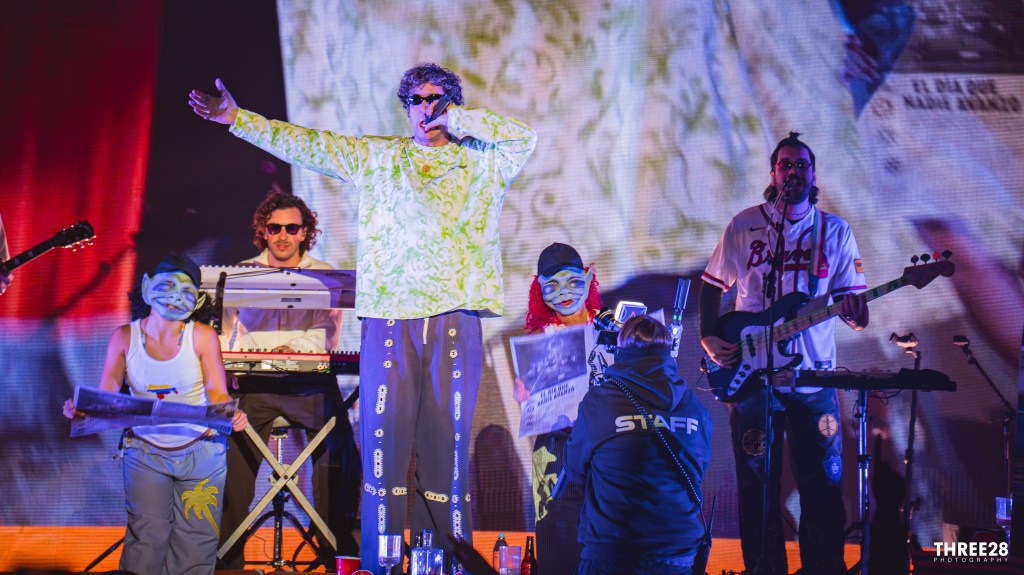
Once the musicians take command of the stage, the production begins to reveal its more extravagant personality. Beto, whose relaxed confidence makes him an especially effective frontman, moves between singing, dancing, and addressing the audience with the ease of someone hosting friends rather than managing a large-scale performance. His most memorable gesture, however, comes when he leaves the main stage for a makeshift platform positioned among the fans. Suddenly, the distance between performer and audience collapses, and Beto is dancing and singing within the crowd rather than simply directing its enthusiasm from above. It is an effective bit of staging because it embodies the band’s larger philosophy: participation matters more than spectacle, even when spectacle is precisely what the production delivers. The other members contribute to that collective identity. Guitarist and vocalist Antonio “Tony” Casas, drummer Andrés “Fofo” Story, and bassist Alejandro “Abeja” Abeijón provide the musical framework that allows the arrangements to move fluidly between reggae-inflected grooves, funk, and pop. Their musicianship is integral to the experience, even when the elaborate production and Beto’s magnetic presence command the most attention. At times, the show’s many moving parts threaten to make the musicians seem like participants in a larger entertainment package rather than the central attraction. Yet the band’s chemistry remains evident, and its rhythmic foundations are sturdy enough to withstand the surrounding theatrics. The crowd does not need to be instructed to dance; it merely needs a beat worth following. Rawayana supplies plenty.
The repertoire draws on the band’s extensive catalog while giving its newer material a prominent place in the evening. “Veneka,” one of the most discussed tracks associated with the group’s recent era, carries particular significance beyond its infectious musicality. Its celebration of Venezuelan identity, especially the word’s complicated history and its reclamation as a source of pride, gives the audience something more substantial than another catchy refrain to shout back. In a crowd filled with Venezuelan jerseys, the song becomes a cultural declaration, transforming individual enthusiasm into a shared expression of identity. The band is at its most persuasive when it allows such meaning to coexist with its easygoing rhythms rather than pausing to explain what the audience already understands. Elsewhere, “Feriado” captures the escapist spirit that runs through the group’s work, with its invitation to set aside obligations and surrender to the pleasure of the moment. These songs demonstrate Rawayana’s knack for creating music that functions simultaneously as entertainment and social glue. The arrangements are accessible, the rhythms are inviting, and the choruses offer plenty of opportunities for communal participation. There is, admittedly, a certain sameness that can emerge when a performance relies so heavily on feel-good momentum. The grooves occasionally prioritize atmosphere over musical surprise, and the relentless emphasis on celebration leaves relatively little space for emotional contrast. Nevertheless, a party need not reinvent itself every ten minutes to justify its existence. Rawayana knows its strengths, and when the audience responds with synchronized dancing and deafening singalongs, the formula proves difficult to dispute.

The female dancers introduce a more surreal dimension to the festivities. Their choreography ranges from conventionally sensual to deliberately bizarre, with alien masks appearing at intervals that seem designed to disrupt the otherwise tropical, neighborhood-party aesthetic. The contrast is amusing, if occasionally bewildering: one moment, the performance evokes a Caribbean street celebration; the next, it resembles an extraterrestrial nightclub that has somehow acquired a taste for Latin funk. The dancers are not merely decorative, since their movements and costumes contribute to the show’s playful refusal to settle into one visual identity. Still, the alien imagery can feel disconnected from the cultural warmth established elsewhere, more like an eccentric flourish than a fully developed concept. Confetti cannons provide a more straightforward form of spectacle, releasing bursts of color over an already animated crowd and pushing the celebration toward its inevitable crescendo. These flourishes are unapologetically theatrical, but Rawayana generally understands when to let them complement the music rather than replace it. The production may occasionally flirt with excess, yet excess is hardly an unreasonable vice for a tour built around the idea of the after-party. Indeed, the title poses a question that the concert answers less through narrative than through sustained energy: the after is wherever the music continues and the people remain. If the show sometimes resembles a meticulously organized simulation of spontaneity, its audience seems perfectly content to accept the arrangement. Nobody appears especially interested in auditing the authenticity of the red cups while confetti is falling overhead.

By the end of the performance, Rawayana has made a persuasive argument for the concert as a communal experience rather than a simple sequence of songs. The sold-out crowd, the Venezuelan flags and jerseys, the tropical stage dressing, and Beto’s excursion into the audience all contribute to a production that understands the emotional power of making people feel included. Its greatest strength is the seamless connection between musical identity and social atmosphere: the band does not merely sing about celebration but constructs an environment in which celebration becomes the audience’s shared responsibility. Its limitations are equally apparent. The show’s visual eccentricities can occasionally overwhelm the musicianship, and its commitment to maintaining a party mood sometimes sacrifices dramatic variation. Yet these are relatively minor shortcomings in a performance whose purpose is not introspection but collective release. Rawayana occupies a distinctive position in Latin alternative music, drawing from Caribbean traditions and Venezuelan cultural identity while embracing the accessibility of contemporary pop. The result is polished without being emotionally sterile, theatrical without becoming entirely impersonal, and exuberant without losing sight of the community that sustains it. The evening’s central achievement is not the confetti or the costumes, nor even the moment Beto dances among the fans. It is the feeling that the audience has briefly become something larger than a collection of ticket holders. As for the question of where the after is, the answer seems obvious: wherever Rawayana sets up the table, fills the red cups, and convinces everyone that tomorrow can wait. The band has found the formula for keeping the party going; fortunately, it also knows how to bring the music.


Leave a Reply