
There is something deliciously poetic about watching a band that built its reputation on unvarnished storytelling embrace the kind of theatrical excess typically reserved for international pop royalty. For Fuerza Regida, however, extravagance is hardly an abandonment of authenticity. Rather, it is the natural progression of an outfit whose ambitions have consistently outgrown the rooms entrusted to contain them. On their aptly titled “This Is Our Dream Tour,” the California-bred architects of a new música mexicana movement arrived at Lakewood Amphitheatre with a production that seemed determined to make one thing abundantly clear: the dream was no longer an aspiration but a gloriously oversized reality. Between the orchestral embellishments, meticulously choreographed lighting, cinematic interludes, and enough wardrobe changes to make a fashion-week producer perspire, Fuerza Regida presented an evening that operated somewhere between a concert, an autobiographical film, and an unapologetic victory lap. Yet beneath the expensive machinery and carefully calibrated spectacle remained the scrappy spirit of musicians who understood that the most compelling part of their success was not merely where they stood, but the improbable road that brought them there.

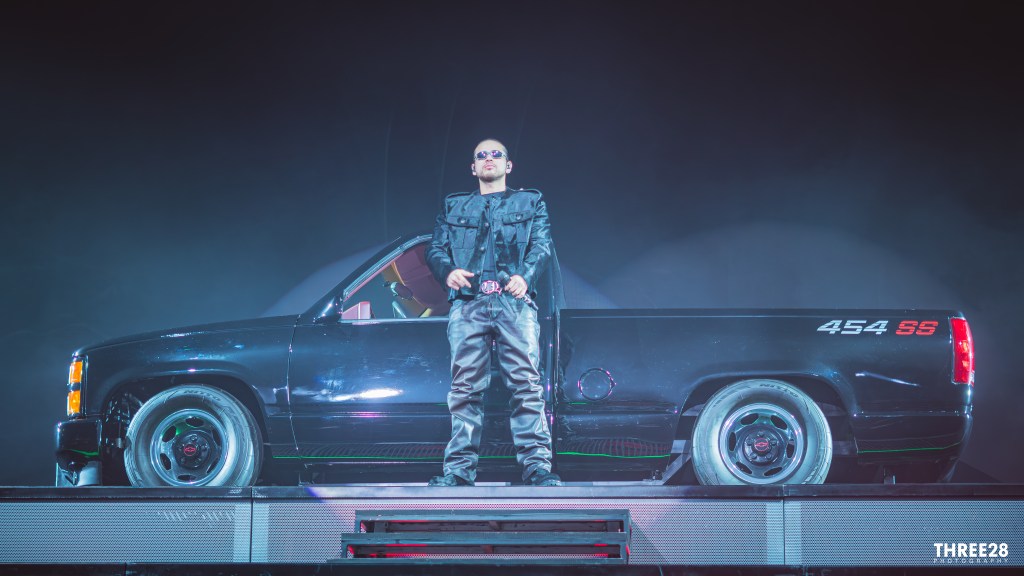
The evening announced its intentions with an entrance that bordered on the mythological. A towering, tiered stage served as the architectural centerpiece, its multiple elevations creating an imposing landscape of platforms, shadows, and anticipation. At its summit, Jesús Ortiz Paz, better known as JOP, emerged dressed entirely in black, positioned alongside a black Chevrolet pickup truck. The imagery was immediately arresting, resembling the opening sequence of a particularly lavish Western reimagined through the visual vocabulary of contemporary street culture. There stood the charismatic frontman, elevated above thousands of admirers, accompanied by a vehicle that functioned as considerably more than an elaborate stage accessory. From a distance, the truck appeared almost aristocratic in its placement, an emblem of automotive bravado perched above an amphitheatre full of devotees. Upon closer inspection, however, its visible scuffs, scratches, and streaks complicated the image. This was not some immaculate showroom trophy polished into anonymity. Its imperfections evoked the workhorses, neighborhood streets, and less glamorous circumstances that informed the group’s earliest chapters. The contrast was exquisite: a band commanding a massive venue with the resources of a major touring enterprise, while displaying a battered reminder of the world it had emerged from. It was a visual metaphor that required neither narration nor explanation. Success might purchase the grandest stage imaginable, but it need not erase the dirt accumulated on the journey.
That juxtaposition between aspiration and origin has been central to Fuerza Regida since their formation in San Bernardino, California, in 2015. Emerging from a landscape where regional Mexican music was frequently treated as an inherited tradition rather than a malleable contemporary force, the group recognized an opportunity to speak to an audience whose cultural identity existed across borders, generations, and musical classifications. Their earliest recordings and performances reflected a street-level sensibility, incorporating the narrative architecture of corridos while embracing the linguistic swagger and aesthetic codes of young Mexican Americans. By 2018, their growing digital presence had helped propel them beyond the limitations of their immediate surroundings, establishing a foundation for the extraordinary commercial expansion that followed. What distinguished Fuerza Regida was not simply their willingness to modernize familiar sounds, but their refusal to regard tradition and innovation as mutually exclusive propositions. They understood that a requinto guitar could occupy the same cultural universe as hip-hop fashion, that accordion-driven melodies could coexist with contemporary urban production, and that regional Mexican music could be presented with the confidence of a global phenomenon without surrendering its identity.
Their importance to the genre becomes particularly apparent when considering the seismic transformation música mexicana has undergone during the past several years. Alongside other influential figures in the corridos tumbados and contemporary regional Mexican movements, Fuerza Regida helped dismantle the assumption that this music belonged exclusively to a particular generation or geographic market. Their success demonstrated that Spanish-language storytelling rooted in Mexican musical traditions could command enormous streaming audiences, penetrate mainstream popular culture, and fill venues once considered the exclusive territory of established crossover superstars. More significantly, the group contributed to a shift in cultural perception. Rather than softening their identity to accommodate conventional industry expectations, they amplified it, presenting themselves as unapologetically products of their environment. Their catalog, spanning hard-edged corridos, romantic confessionals, party anthems, and genre-blurring experiments, illustrates a restless creative appetite. The emergence of songs such as “Bebé Dame,” “TQM,” and “Harley Quinn” further demonstrated their ability to navigate disparate emotional and stylistic registers while maintaining an unmistakable musical fingerprint. At Lakewood Amphitheatre, that accumulated influence was palpable, not as an abstract industry accomplishment, but as a living exchange between performers and an audience that had adopted their songs as part of its own cultural vocabulary.
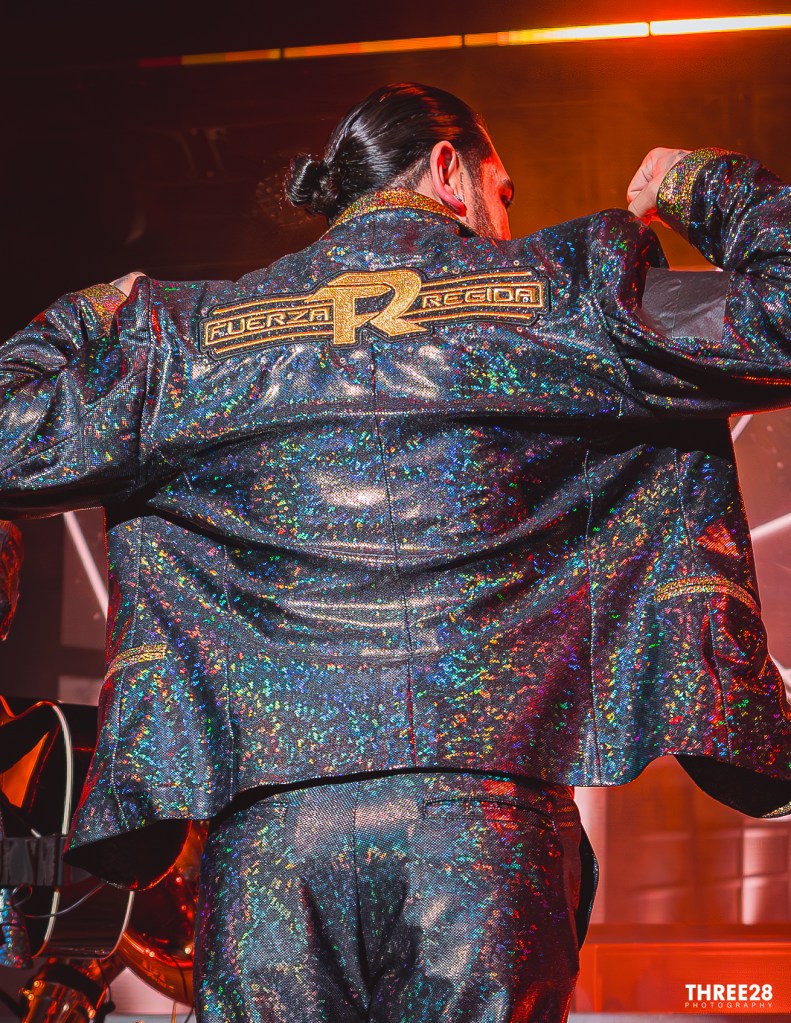
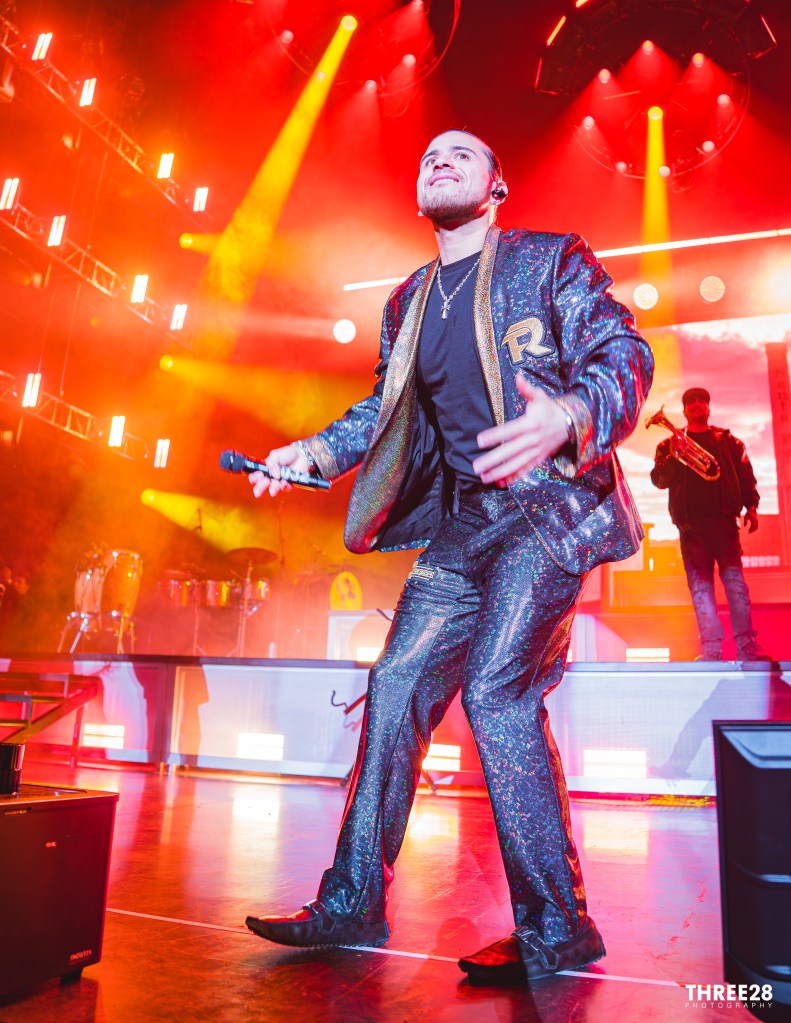
At the center of this elaborate undertaking stood Ortiz Paz, a frontman whose greatest asset might be his ability to project the familiarity of a neighborhood acquaintance while occupying the commanding position of a bona fide celebrity. His stage presence was equal parts mischievous, confrontational, and magnetic, with an instinctive understanding of how to manipulate the temperature of a crowd. He moved through the production with the self-assurance of someone entirely comfortable inhabiting his own mythology, occasionally allowing the bravado to dissolve into moments of genuine appreciation. His numerous costume changes became a spectacle unto themselves, a revolving wardrobe of meticulously assembled looks that transformed the evening into an unlikely intersection of corridos and haute couture. There were so many sartorial reinventions that keeping track became almost comically ambitious. Each new ensemble seemed to introduce another chapter of the performance, with clothing functioning as an extension of the musical atmosphere rather than mere decoration. The frequency of these transformations might have seemed indulgent in less capable hands, but here they underscored the contradictions that make Fuerza Regida fascinating: streetwise irreverence wrapped in increasingly luxurious presentation, a working-class sensibility dressed for the penthouse.
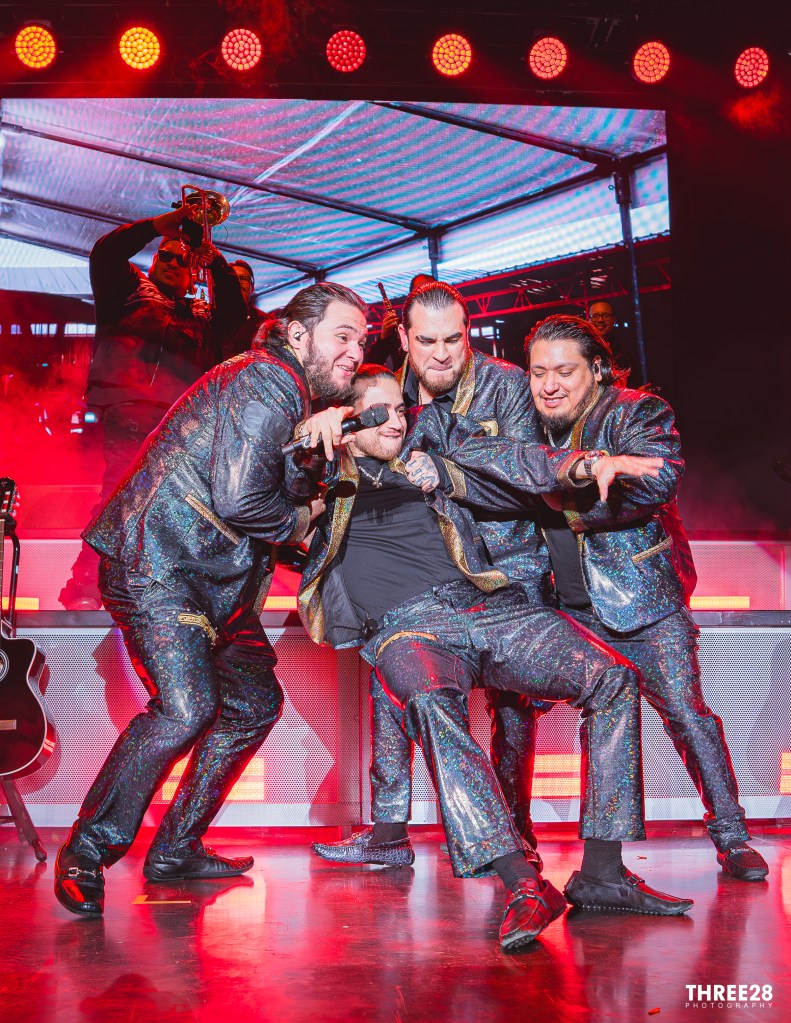

Although Ortiz Paz naturally commanded much of the attention, the musical foundation beneath his showmanship remained indispensable. Fuerza Regida has never been merely a singer accompanied by interchangeable instrumentalists; its identity is inseparable from the interplay between the musicians responsible for constructing its distinctive sound. José “Pelón” García supplied the tuba presence that gives so much of the group’s repertoire its muscular low-end propulsion, turning an instrument associated with longstanding regional traditions into an engine of contemporary swagger. Requinto guitarist Samuel Jaimez contributed the nimble melodic articulation that lends the arrangements their unmistakable character, his instrument weaving intricate passages through the rhythmic foundation. Khrystian Ramos, on rhythm guitar, provided the harmonic framework and percussive momentum essential to the music’s forward motion, while Moisés López, associated with the tololoche, represents another vital connection to the acoustic lineage from which the group draws its vocabulary. Together, these musicians embody the ensemble discipline required to make deceptively straightforward compositions resonate with such force. Their contributions also serve as a useful reminder that behind the elaborate staging and celebrity-sized personality lies a band whose original appeal was built on musical chemistry, not technological wizardry.
For this tour, that instrumental chemistry was expanded through the presence of an accompanying orchestra, a decision that elevated the arrangements beyond their familiar dimensions. The juxtaposition was particularly effective because it did not seek to disguise the regional Mexican foundations of the material. Instead, the additional instrumentation gave the compositions greater emotional breadth, surrounding their recognizable melodic contours with an almost symphonic sense of occasion. The effect was especially compelling when the music shifted between intimacy and bombast, allowing delicate passages to acquire a richer atmosphere before erupting into full-bodied celebrations. There is an inherent audacity in bringing orchestral sophistication into a musical universe frequently characterized by its gritty directness, but Fuerza Regida appeared entirely uninterested in respecting such artificial distinctions. Their performance suggested that corridos could be presented with the same dramatic scale afforded to classical crossover productions or arena-rock extravaganzas. The orchestra was not simply an expensive ornament positioned to impress spectators. It served as another narrative instrument, magnifying the emotional stakes of songs that had already accumulated considerable meaning for the people singing along.
Equally essential was the production’s remarkably imaginative visual language. The lighting design rarely settled for straightforward illumination, instead treating the stage as an evolving environment capable of shifting moods within seconds. Sharp beams sliced through the darkness, luminous washes transformed the tiered architecture, and carefully timed bursts of brightness punctuated musical climaxes with almost surgical precision. Particularly memorable were the circular lighting fixtures suspended above the performance area, whose futuristic configurations suggested portals ripped from the imagination of a science-fiction filmmaker. As they glowed, shifted, and seemingly reconfigured the space beneath them, the structures resembled machinery designed for temporal displacement, as though Fuerza Regida had commissioned its own time-travel apparatus. The symbolism was unexpectedly appropriate. Throughout the evening, the band moved between its present-day magnificence and recollections of considerably more modest circumstances. Those hovering rings might as well have been transporting the musicians between different periods of their existence, allowing yesterday and tomorrow to occupy the same spectacular stage. In a production already overflowing with visual ambition, these celestial contraptions supplied one of its most memorable flourishes.
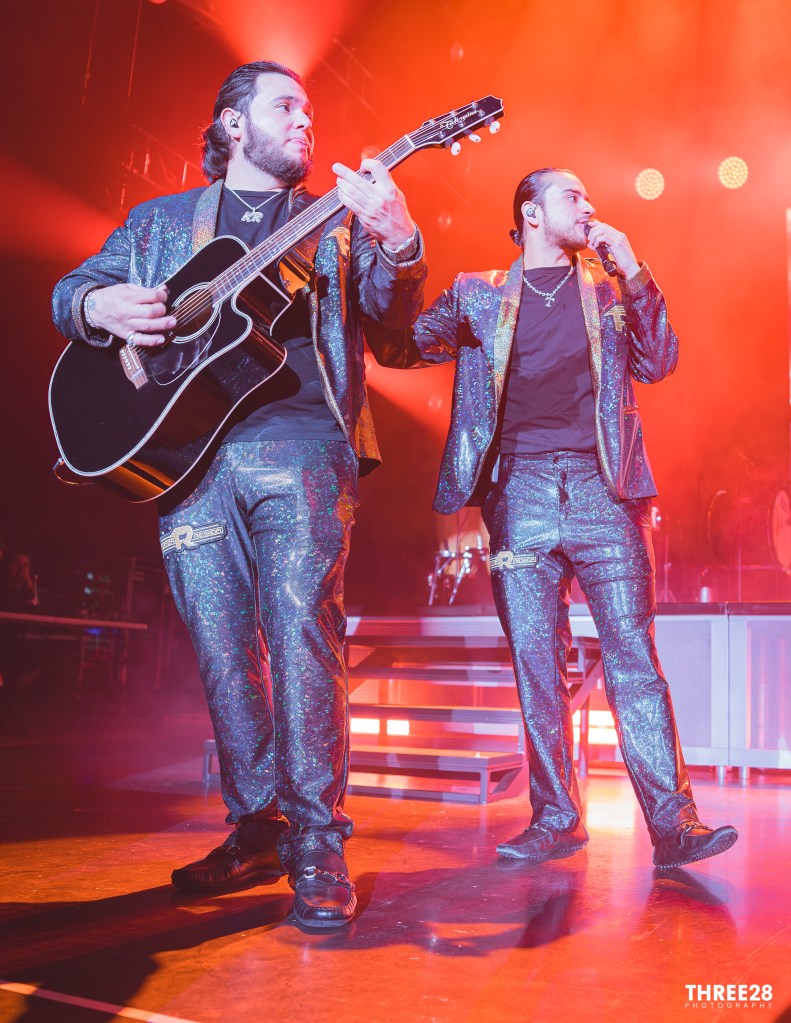
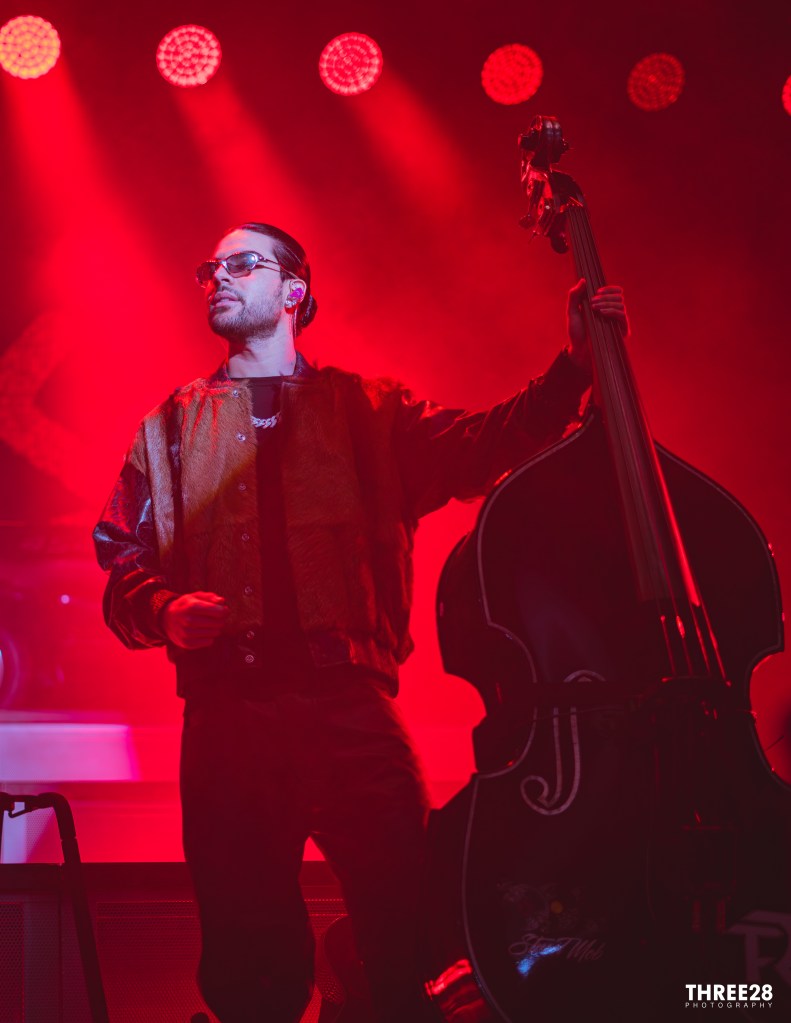
The evening also borrowed extensively from the grammar of cinema, incorporating short, trailer-like sequences before various performances. Rather than allowing songs to arrive in uninterrupted succession, Fuerza Regida frequently framed them through miniature audiovisual presentations that created anticipation and established thematic context. These interludes resembled promotional teasers for imaginary motion pictures, complete with dramatic imagery and a deliberate sense of narrative escalation. The approach gave the concert an episodic structure, as though the audience were watching a feature-length account of the group’s evolution told through music, movement, and spectacle. It was a clever solution to a familiar challenge confronting large-scale touring productions: how to sustain dramatic momentum across a lengthy repertoire without reducing the performance to a sequence of increasingly predictable hits. Here, the transitions became attractions in their own right. The cinematic material provided breathing room for costume changes, reinforced the evening’s autobiographical themes, and heightened the anticipation surrounding what would follow. Occasionally, the sheer abundance of production elements threatened to overshadow the simpler pleasures of watching a group perform, but even that excess seemed consistent with the tour’s central philosophy. When the subject is the realization of an extraordinary dream, understatement can feel almost beside the point.
For all the elaborate technology, however, some of the most engaging moments were delightfully uncomplicated. Roses were tossed toward the audience, introducing an unexpectedly romantic gesture into a night otherwise dominated by bravado and thunderous musical declarations. Beach balls bounced across the crowd, transforming sections of the amphitheatre into a sprawling, participatory playground. These playful exchanges temporarily dissolved the distance between the elevated stage and the spectators gathered below it. They also demonstrated an important aspect of Fuerza Regida’s appeal: their understanding that a concert is not merely a display of artistic achievement but a communal celebration in which the audience deserves an active role. The juxtaposition of flowers, inflatable spheres, orchestral accompaniment, and futuristic illumination was gloriously absurd, yet somehow entirely coherent within the group’s universe. Few performers could move so comfortably between sentimental gestures and rowdy amusement without making the transitions feel contrived. Fuerza Regida managed it by approaching both with the same exuberance, allowing the evening to alternate between emotional sincerity and mischievous disorder.
Perhaps the most revealing exchanges came when Ortiz Paz turned his attention toward the group’s history, invoking its earliest years and asking who among those present had been supporting Fuerza Regida since 2018. The question, delivered with the sort of profane familiarity that has always characterized the band’s public persona, amounted to something more meaningful than a routine request for applause. Asking whether people had been fucking with them since those formative days was an invitation to distinguish the original believers from those who discovered the phenomenon after its ascent became impossible to ignore. Yet it was not necessarily an exercise in gatekeeping. Rather, the exchange recognized the audience as an essential participant in the story. Those who had followed the band through its less glamorous chapters were being offered an opportunity to celebrate their own foresight, while newer admirers were welcomed into a movement whose origins remained central to its identity. The moment also carried a pleasing irony. Here was a group performing amid extraordinary technical resources, asking a vast gathering to remember a time when its future was anything but guaranteed. The battered Chevrolet positioned high above the stage suddenly seemed even more consequential. It was not merely a nostalgic prop; it was a physical reminder that every glittering achievement has an unpolished beginning.


That persistent conversation between past and present ultimately supplied the performance with its emotional architecture. It would have been easy for Fuerza Regida to approach a production of this magnitude as an opportunity to demonstrate wealth, influence, and cultural supremacy. Certainly, there was no shortage of conspicuous expenditure on display. The multiple wardrobe transformations, architectural staging, orchestral arrangements, and elaborate lighting apparatus made the evening a formidable demonstration of commercial muscle. But the band also seemed aware that luxury without perspective can become an empty exercise in self-congratulation. By repeatedly referencing its beginnings, Fuerza Regida gave the spectacle a purpose beyond visual astonishment. The concert became an exploration of what happens when musicians who once operated on the margins of mainstream recognition acquire the means to build an entire universe around their songs. Rather than replacing their identity with the polished anonymity of conventional superstardom, they brought their own cultural references, humor, language, and musical inheritance into a setting capable of amplifying them to monumental proportions.
There was also a broader significance to the performance that extended beyond the accomplishments of any individual musician. For decades, regional Mexican music occupied a peculiar position within the American entertainment industry: enormously popular among its devoted audiences, yet frequently underestimated by institutions that measured cultural importance through narrower definitions of mainstream success. Fuerza Regida belongs to a generation of artists that has rendered those distinctions increasingly obsolete. Their commercial achievements and formidable touring presence have helped demonstrate that música mexicana requires neither translation nor aesthetic compromise to compete at the highest levels of contemporary entertainment. The spectacle illustrated that transformation with unusual clarity. Here was a production possessing the technical sophistication of a major international tour while remaining unmistakably rooted in the sounds and experiences of a particular cultural community. The achievement was not that Fuerza Regida had somehow escaped regional Mexican music to become something bigger. It was that they had helped expand the perceived possibilities of the genre itself, bringing its instruments, narratives, and cultural codes into spaces that once seemed resistant to their inclusion.
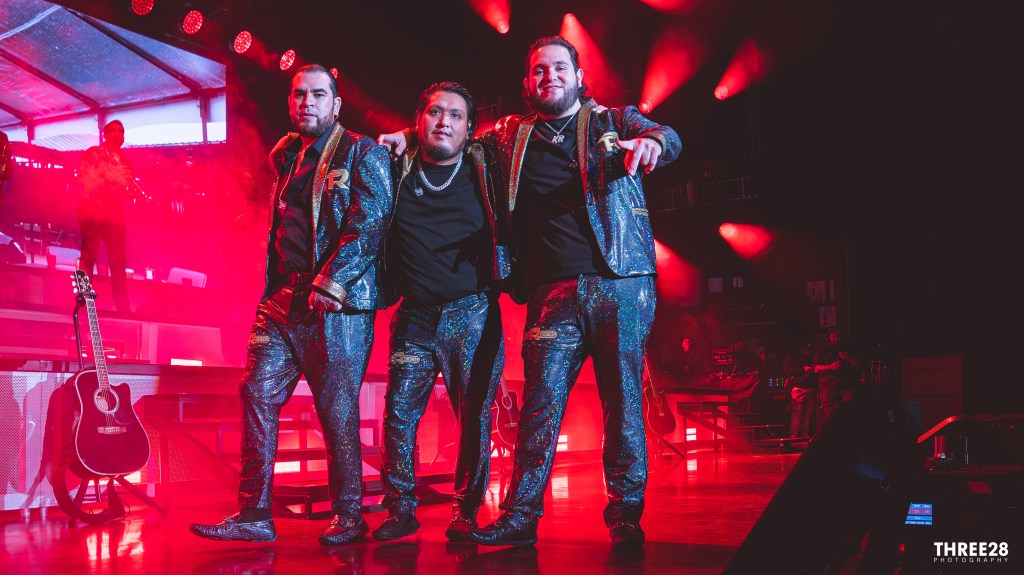
By the end of the evening, the title “This Is Our Dream Tour” felt less like promotional branding than a statement of artistic intent. Fuerza Regida had constructed a production that celebrated success without entirely sanitizing the struggle that preceded it, balancing extravagant showmanship with reminders of the band’s formative identity. The entrance beside the weathered black pickup, the endless parade of outfits, the orchestra, the theatrical interludes, the roses and beach balls, and those extraordinary time-machine-like lights all contributed to a performance whose ambition occasionally approached the ridiculous, but rarely the forgettable. Its greatest triumph was not simply its ability to dazzle, but its insistence that the journey deserved as much attention as the destination. Somewhere between the scratches on that Chevrolet and the radiant machinery suspended overhead existed the essence of Fuerza Regida: a group still carrying the marks of its origins while reaching for possibilities that once belonged exclusively to imagination. Dreams, after all, are most satisfying when their realization does not require forgetting who dared to have them in the first place.


Leave a Reply